
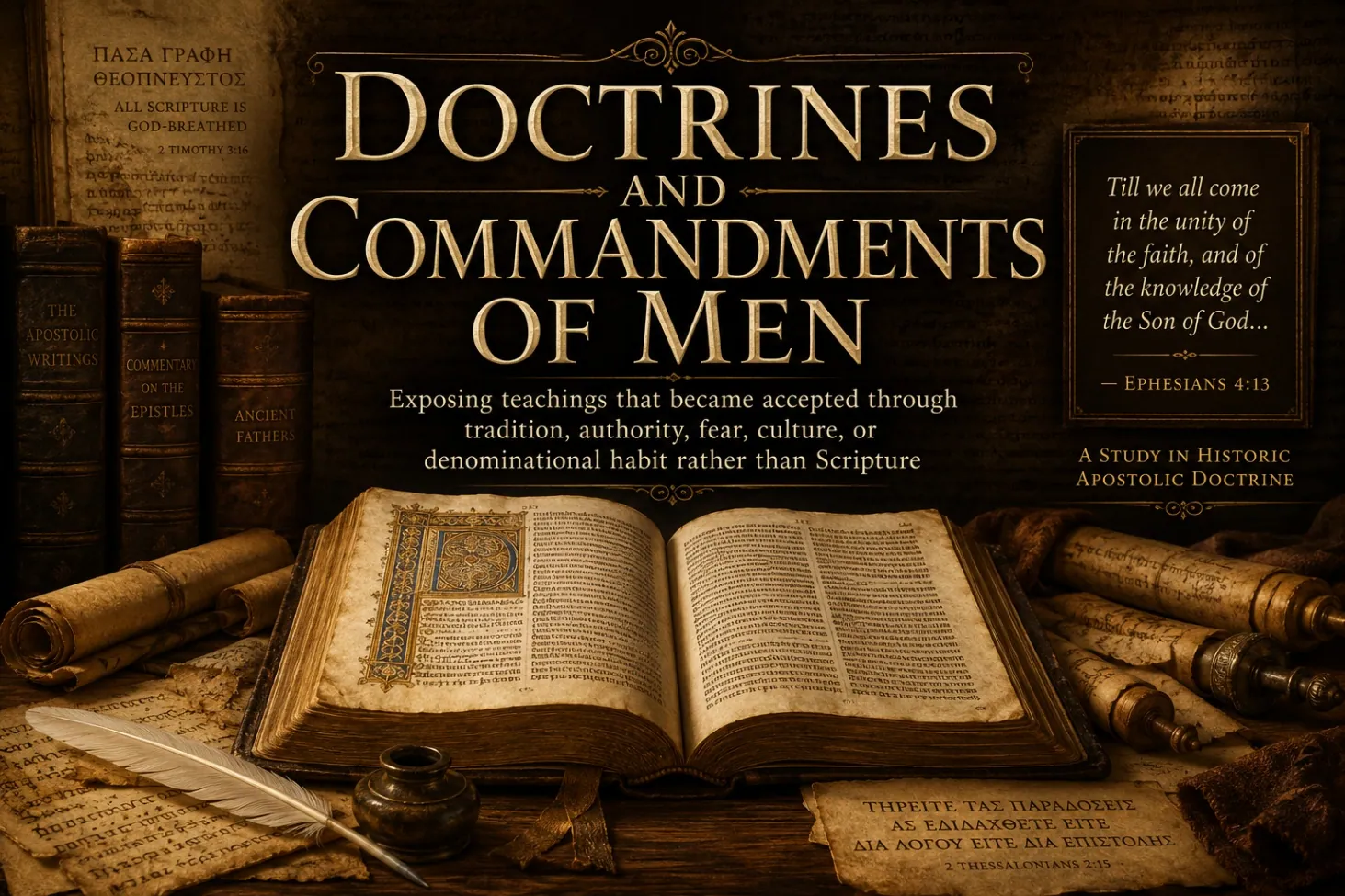
“But in vain they do worship me, teaching for doctrines the commandments of men.”
This study is directed to Oneness Apostolic ministers and saints, and it does not attack or weaken biblical holiness, nor does it excuse worldliness. It confronts a different corruption and the opposite error: the addition of rules, doctrines, financial demands, ministerial preferences, and controlling practices that God never commanded, that the apostles never taught, and that frequently benefit those who enforce them. The study exposes the problem and calls the church back to the doctrine, spirit, priorities, and pattern of the apostles.
1. When Human Rules Are Preached as Divine Law
The gravest danger facing a church is not always open unbelief. Sometimes it is religion that speaks in God’s name while teaching what God never said. Jesus did not treat this as a harmless difference of opinion. He said worship becomes vain when the commandments of men are taught as doctrine. A rule does not become holy because it is preached loudly, repeated for decades, printed in a manual, or enforced by respected ministers.
The issue is not whether a custom appears strict, conservative, or spiritually serious. The issue is authority. Where did God command it? Where did Jesus teach it? Where did the apostles require it of the church? When those questions cannot be answered from Scripture, the teaching must not be imposed upon the conscience of the saints. Personal conviction may guide an individual, but personal conviction is not universal law.
Many modern Oneness Pentecostal congregations have inherited rules that are defended by custom rather than text. When questioned, the answer is often, “That is how we have always believed,” “Our pastor does not allow it,” or “Our organization teaches it.” None of those statements is Scripture. They reveal the real source of authority: tradition, personality, and institutional expectation.
This must be confronted because the consequences are severe. Human rules create guilt where God did not create guilt, obedience where God did not command obedience, and condemnation where God did not pronounce condemnation. They turn the church from a people governed by truth into a people governed by fear, tradition, manipulation, and personal agenda.
2. Making the Word of God of None Effect
Jesus accused religious leaders of “making the word of God of none effect” through their tradition. Tradition does not merely sit beside Scripture. When it is elevated to divine status, it competes with Scripture, obscures Scripture, and eventually nullifies Scripture in practice. People begin to fear violating church culture more than they fear violating the Word of God.
This inversion can be seen whenever minor human restrictions receive more attention than mercy, truth, justice, integrity, humility, and love. A saint may be scrutinized over a custom that has no clear biblical command while pride, favoritism, dishonesty, financial manipulation, materialism, opulence, gluttony, and cruelty are excused. Jesus condemned leaders who strained at a gnat and swallowed a camel.
The church cannot claim to defend holiness while neglecting what holiness actually requires. Biblical holiness is separation unto God, purity of heart and conduct, obedience, mercy, truth, modesty, faithfulness, and love. Man-made religion reduces holiness to a list that can be monitored externally, then allows those who enforce the list to escape deeper examination.
Whenever a teaching weakens the plain force of Scripture, it must be rejected. Whenever a custom becomes more binding than an apostolic command, it has become an idol. Whenever ministers defend an inherited rule more fiercely than they defend truth, repentance, mercy, and righteousness, tradition has already displaced the Word of God.
3. Pastoral Authority Has God-Established Boundaries
Pastors are commanded to feed the flock, guard the church, teach sound doctrine, correct error, and live as examples. They are not authorized to become lords over the faith, conscience, homes, finances, or private decisions of the saints. Peter explicitly forbade ministers from being “lords over God’s heritage.” Paul likewise said, “Not for that we have dominion over your faith.”
A minister’s office does not transform his preference into God’s command. He may offer counsel, explain wisdom, and warn of danger, but he must distinguish counsel from commandment. When he speaks where Scripture is silent and demands obedience as though God Himself had spoken, he exceeds his authority and places himself between Christ and the believer.
Control is often disguised as protection, submission, loyalty, or pastoral care. Yet biblical shepherding does not require saints to surrender their judgment, cease searching Scripture, or obey unsupported demands. Every Spirit-filled believer has a personal responsibility to pray, seek God, search the Scriptures, and discern His direction and will for his or her own life. A pastor should teach, counsel, warn, and offer godly guidance, but he must not interfere with or replace that individual responsibility required by the Word of God.
The Bereans were called noble because they examined even apostolic preaching by the Scriptures. That principle still applies. A healthy church does not fear honest examination; it encourages it. When believers are discouraged from questioning unsupported teachings, seeking God for themselves, or comparing pastoral instruction with Scripture, the issue is no longer protection of truth—it is protection of control.
Ministers must understand the seriousness of this offense. To bind what God has not bound is to misrepresent God. To threaten saints with spiritual consequences for disobeying a human rule is to use divine authority falsely. The pulpit must never become an instrument for personal convenience, institutional preservation, financial security, or domination.
This abuse is not always carried out through direct commands. Sometimes it is far more subtle. Personal preferences may be presented as though they reflect God's pleasure or displeasure. Believers may be led to feel that questioning a pastor's preference is a sign of rebellion, a lack of submission, or evidence of a poor spiritual attitude. Others may be denied opportunities to teach, serve, or participate in certain areas of ministry until they conform to expectations that Scripture itself never imposes. Shame, guilt, social pressure, and the fear of disappointing spiritual leaders can become powerful tools for enforcing man-made standards without ever openly claiming, "Thus saith the Lord." Yet whether authority is exercised through explicit commands or through subtle pressure and implied spiritual consequences, the result is the same: human preferences begin to function as though they were the commandments of God.
Admittedly, there may be times when a believer may not be violating an explicit command of Scripture, yet the spirit behind the behavior still requires discernment and correction. The Bible does not forbid a man from wearing a beard or facial hair, but a man may still adopt exaggerated or worldly styles for the purpose of drawing attention to himself, expressing pride, or identifying with ungodly trends. Likewise, Scripture does not prescribe one exact form of dress for women, and pastors must be careful not to create rules where God has not spoken. Yet a woman may still choose clothing or hair barrettes that are intentionally flamboyant, provocative, or attention-seeking, just as a man may wear something deliberately distracting or behave on the platform in a way designed to make himself the center of attention. Running across pews, standing on top of the pulpit, wearing deliberately outrageous clothing, or adopting extreme styles may not always violate a specific written command, but the spirit of pride, vanity, disorder, or self-exaltation can still be contrary to the character of Christ.
This is where biblical pastoral discernment has a proper place. The pastor is not authorized to invent commandments, but he is responsible to address attitudes and conduct that disturb order, glorify self, or undermine the spiritual atmosphere of the church. The correction should therefore focus on the spirit, motive, and effect of the behavior rather than pretending that a personal preference is itself a divine law. That distinction protects both sides: it prevents pastors from creating unsupported standards, while also preventing believers from using “the Bible does not specifically forbid it” as an excuse for pride, worldliness, disorder, or attention-seeking.
4. The Assumed Authority of the Pastor
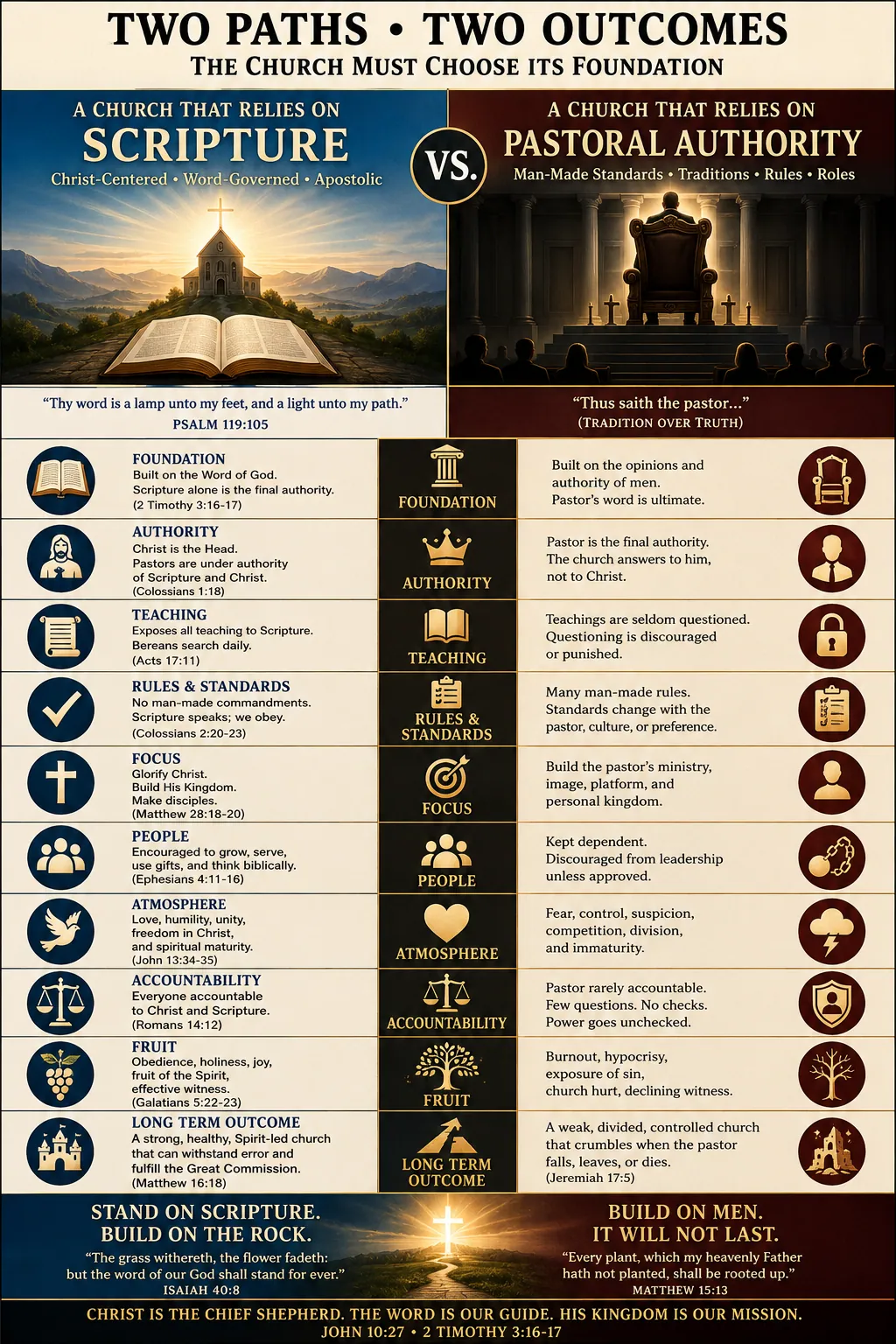
Across most Apostolic churches, pastors openly claim they have the authority to establish standards and rules for their own assemblies. This claim has become so widely accepted that many church members assume it is biblical without ever asking whether God actually granted such authority. Yet no such authority is given in Scripture. This is not a harmless administrative practice. It is an abuse of pastoral authority. A pastor may decide service times, organize ministries, and oversee the practical affairs of the church, but he has no authority to invent spiritual requirements, define holiness by personal preference, or demand obedience where Scripture has not spoken. Yet believers are routinely told, “Our pastor teaches it,” “The pastor said it,” or “The pastor has the authority to set the standards here,” as though those statements settle the matter. They do not. No pastor’s opinion becomes the Word of God simply because he speaks it from a pulpit.
This is exactly what the Pharisees did. They added their own traditions to the commandments of God, bound those traditions upon the people, and then treated disobedience to human rules as disobedience to God. Jesus condemned them for teaching “for doctrines the commandments of men…”, adding that in doing so, “…in vain they do worship me”. Modern pastors repeat the same offense when they place believers under rules that Christ and His Apostles never commanded. They are not merely bringing people back under the Law; in many cases they go beyond the Law and create an even heavier system of local demands. Peter warned against placing upon the disciples a yoke “which neither our fathers nor we were able to bear” (Acts 15:10). No minister has the right to put that yoke back upon the Church under the excuse that “the pastor has the authority.”
When a pastor claims the right to create binding standards beyond Scripture, he exalts himself above the written Word and places himself between Christ and the believer. In principle, this resembles the Catholic system in which a religious leader’s rulings are treated as divinely authoritative and beyond question. No pastor is infallible. No local assembly has the right to create its own doctrine, its own version of holiness, or its own commandments. Christ alone is Lord of the Church, and every pastor, rule, standard, and tradition must submit to Scripture. Anything beyond that is not Apostolic authority. It is spiritual domination.
5. The Test Is Scripture, Not Sincerity or Tradition
Sincerity cannot make error true. Age cannot make tradition apostolic. Popularity cannot make a doctrine biblical. And words coming across a pulpit cannot create commandments God never gave. The only safe test is the Word of God rightly understood in its context. Scripture is sufficient to furnish the man of God thoroughly unto all good works. If a rule is necessary for salvation, holiness, church membership, or Christian faithfulness, Scripture must establish it.
The saints have both the right and the responsibility to ask, “Where is that in the Bible?” That question is not rebellion. It is obedience to the command to prove all things and hold fast that which is good. Ministers who teach truth should welcome examination because truth does not fear an open Bible.
Weak answers expose weak doctrine. A string of unrelated verses, an Old Testament command removed from its covenant, a preacher’s anecdote, an appeal to organizational policy, or a warning not to question authority is not a biblical foundation. Doctrine must arise from the text, not be imposed upon the text after the conclusion has already been chosen.
Every inherited teaching must return to trial. The question is not whether our fathers preached it, whether our organization requires it, or whether abandoning it would be uncomfortable. The question is whether Jesus and the apostles taught it. Anything that cannot withstand that examination must not continue to govern the church.
One man once remarked that he had been taught for sixty-nine years that a Christian man should not wear a beard. He went on to say that if he ever saw a bearded man walk behind the pulpit, he would immediately walk out. Whether he realized it or not, his statement revealed something far more serious than a personal opinion about facial hair. He was openly acknowledging that for nearly seven decades he had accepted and defended a religious tradition without ever personally questioning or examining whether it could be supported from Scripture. Rather than asking, "What does the Word of God teach?" the tradition itself and ministerial overreach had become the authority. This illustrates the very danger Jesus warned against when He rebuked those who taught "for doctrines the commandments of men." Every believer has a personal responsibility to search the Scriptures and ensure that his convictions rest upon the Word of God rather than inherited traditions, no matter how long those traditions have been accepted.
The amount of bickering online and inside our churches and local assemblies themselves—over standards and man-made rules is obscene. The pride, division, suspicion, and spiritual competition these disputes have generated have become a curse upon the mission of Christ. They accomplish nothing of lasting value, weaken fellowship, distract from the Gospel, and often elevate personal preferences above the Word of God.
Yet this problem cannot be corrected as long as ministers remain free to create their own standards, ignore the biblical limits placed upon pastoral authority, and misuse Scripture to defend rules the Apostles never taught. Pastors must be willing to come clean, acknowledge where tradition has replaced Scripture, and re-educate the church with humility: we are going to stand upon the Word of God. That does not eliminate our responsibility to holiness, obedience, discipline, or a purpose-driven life that seeks to please God and fulfill His will. It does the opposite. It restores Christ to the center, elevates Scripture above tradition, and calls us away from doctrines and requirements that were never stated, commanded, or taught by the Apostles.
6. Man-Made Religion Produces Division and Confusion
When preferences are preached as doctrine, churches divide over matters God never made tests of fellowship. One congregation condemns what another permits. One minister declares sinful what another minister regards as harmless. Saints move from church to church and encounter different “standards,” each presented as though it came directly from heaven. This is not apostolic unity. It is institutional confusion. It inherently leads to division, confusion, self-righteousness, judgementalism, and diversion from the higher calling of the church: to live a life pleasing to the Lord, promote unity and peace, care for the poor and needy, and to bring salvation the lost.
Such division is inevitable because human rules have no fixed biblical boundary. Once ministers are permitted to legislate beyond Scripture, every personality can add a new restriction. The strictest voice is often treated as the most spiritual, and fear drives continual expansion. The result is not holiness but competition, suspicion, and judgment. Others break away and go to the other extreme of rejecting Biblical precepts and holiness altogether.
Paul commanded believers not to judge one another in matters where God has not issued a universal command. That principle does not erase clear moral teaching; it protects the church from elevating disputed or personal matters into conditions of righteousness. Where Scripture commands, the church must obey. Where Scripture allows liberty, ministers must not create bondage.
The confusion damages families, congregations, and fellowship. Saints become afraid to think, ask questions, or admit uncertainty. Ministers measure loyalty by conformity to local expectations. Churches that should be united by the gospel are separated by rules the apostles never knew. This is a scandal that must end.
7. Sinners Recognize When Our Claims Cannot Be Defended
Sinners often enter our churches with honest questions. They hear a command, restriction, financial demand, or doctrinal claim and ask, “Where is that in the Bible?” Too often, we cannot answer them plainly because the teaching did not come from the Bible. Instead of producing a text, we produce a tradition, a threat, an organizational rule, or an appeal to pastoral authority.
The world may reject biblical truth, but it can also recognize inconsistency. People see when churches condemn practices without scriptural proof, demand submission without accountability, or preach sacrifice to the poor while protecting privilege at the top. They recognize control even when religious language is used to conceal it.
When sincere seekers walk away because they encounter manipulation, contradiction, and unsupported teaching, we must not casually accuse them of rebellion or lack of hunger. Some leave because they have seen a church demand what Christ did not demand. We cannot claim persecution for truth when the offense was created by our own additions. If they reject Christ and His great salvation, let not be because of our words, actions, or attitudes.
The answer is not to weaken biblical doctrine. The answer is to remove what is not biblical so the true offense of the gospel stands by itself. Let sinners confront repentance, the name of Jesus Christ, the Holy Ghost, holiness, resurrection, judgment, and discipleship—not a maze of invented rules that neither Jesus nor the apostles imposed.
8. Financial Systems Must Also Face Biblical Examination
No practice is exempt from biblical examination merely because the church depends upon it financially. Material need does not create scriptural authority. A teaching cannot be justified by saying that buildings, salaries, programs, and organizations require it. The church must follow the apostolic prescription, then order its finances accordingly. There is serious abuse regarding this principle in our churches. Pastors must be good stewards in financial matters like the rest of the saints. Poor financial management and excessive spending does not excuse or justify pressure, guilt, and manipulation of the body of Christ.
The New Testament presents willing, generous, sacrificial giving—not ministerially enforced taxation. The apostles taught believers to give purposefully, cheerfully, and according to ability. They cared for the poor and supported gospel labor, but they did not manipulate giving through fear, threats, or misused covenant texts.
Whenever ministers use Scripture selectively to protect income, they have allowed personal and institutional benefit to govern doctrine. This is especially serious because those who control the pulpit also control the interpretation presented to the congregation. Financial teaching must therefore be handled with exceptional honesty and transparency.
Pastors are not exempt from the command to submit every doctrine to Scripture. If a financial practice cannot be established from the teaching and example of the New Testament church, it must not be presented as a divine obligation. Man-made justifications for man-made doctrines will not stand on the day of judgment.
9. Personal Conviction Must Not Become Universal Law
Personal conviction has an important place in Christian life. A believer may abstain from something because of conscience, past weakness, family responsibility, or a desire for greater separation. That conviction should be honored. But it becomes an offense when it is imposed upon every saint as a command of God. A pastor may react to a single event that offended him and suddenly impose a new doctrine upon the Church. A pastor may have had a personal experience that motivated him to take scripture out of context to impose a new rule. Or a pastor may simply pursue his own agenda, selectively building his own empire while disregarding the boundaries established by Scripture, Apostolic doctrine, and Apostolic precedent.
Ministers are especially vulnerable to this error because their influence gives personal preferences institutional force. The most common cause of this overreach is that a pastor may like or dislike a practice, style, activity, or decision and gradually preach his conviction as a spiritual principle. The congregation accepts his previously conveyed extensive pastoral authority and one man’s preference suddenly becomes ‘apostolic doctrine’. The church then carries this message to others and to sinners where it causes much controversy and harm, and people turn away from the kingdom of God altogether.
Paul allowed believers to hold differing convictions in matters not universally commanded, while forbidding contempt and judgment. Christian liberty must never be used as an excuse for sin, but neither may the fear of liberty justify ministerial legislation. God alone is Lord of the conscience.
The honest minister will say, “This is my counsel,” when he means counsel; “This is my conviction,” when he means conviction; and “Thus saith the Scripture,” only when Scripture actually says it. That distinction protects both pastoral credibility and the freedom of the saints.
10. Ministers and Saints Must Repent of Religious Pride
Man-made religion survives because it flatters spiritual pride. It allows people to compare themselves by visible rules, institutional loyalty, and group identity. We tell ourselves that our strictness proves our faithfulness, even when some of our strictness has no apostolic foundation.
Ministers may resist correction because admitting error appears to weaken authority. Saints may resist correction because their identity has been built around sacrifices God never required. Entire organizations may defend inherited teachings because too much reputation, money, and history are attached to them. None of these motives can make error acceptable.
Repentance means more than apologizing for harsh methods while preserving false doctrine. It means identifying what God did not command, ceasing to bind it, correcting the record, and releasing the saints from guilt and fear. It may require ministers to contradict their former preaching openly.
The church cannot be restored while protecting its pride. God gives grace to the humble, not to those who defend tradition at the expense of truth. We must be willing to lose face in order to regain faithfulness.
11. A Final Charge: Remove Every Addition
God has always forbidden men to add to His Word. The warning applies not only to written alterations but to every attempt to attach divine authority to human teaching. We have no right to make the narrow way narrower than God made it, nor to build fences and then condemn everyone who crosses our fence.
Ministers must stop using the pulpit to preserve preferences, systems, and traditions that cannot be established from Scripture. Saints must stop surrendering their conscience to unsupported authority. Organizations must stop confusing uniformity with unity and policy with doctrine.
This correction will not destroy true holiness. It will purify it. It will remove counterfeit burdens so the actual commandments of God can be seen, obeyed, and loved. It will allow the church to speak with moral clarity because we will no longer be defending claims we cannot prove.
The question before every minister and saint is simple: Are we willing to obey God even when obedience requires abandoning what our people, our predecessors, or our organization taught us? If not, then tradition—not Scripture—is our final authority.
Continue the Study
This Bible study introduces only part of a much larger need for examination and restoration within the modern Oneness Pentecostal church. Additional Bible studies—including Restoring Apostolic Truth—are available through The Present Kingdom website for those who desire to examine these subjects more fully.
The Present Kingdom was established to help restore the historic Apostolic faith delivered by Jesus Christ through His apostles—including the doctrine, order, ministry, authority, spiritual life, and practice of the New Testament church. Its purpose is to bring every inherited teaching, tradition, organizational practice, and ministerial system back beneath the authority of Scripture.
The modern Oneness church has preserved important truths, but it has also drifted in significant areas from the doctrine and practice of the apostles. Restoration requires more than defending our denominational identity. It requires the humility to examine everything, retain what is scriptural, and abandon whatever rests upon the commandments and traditions of men.
Readers are encouraged to continue with other studies available through The Present Kingdom website.