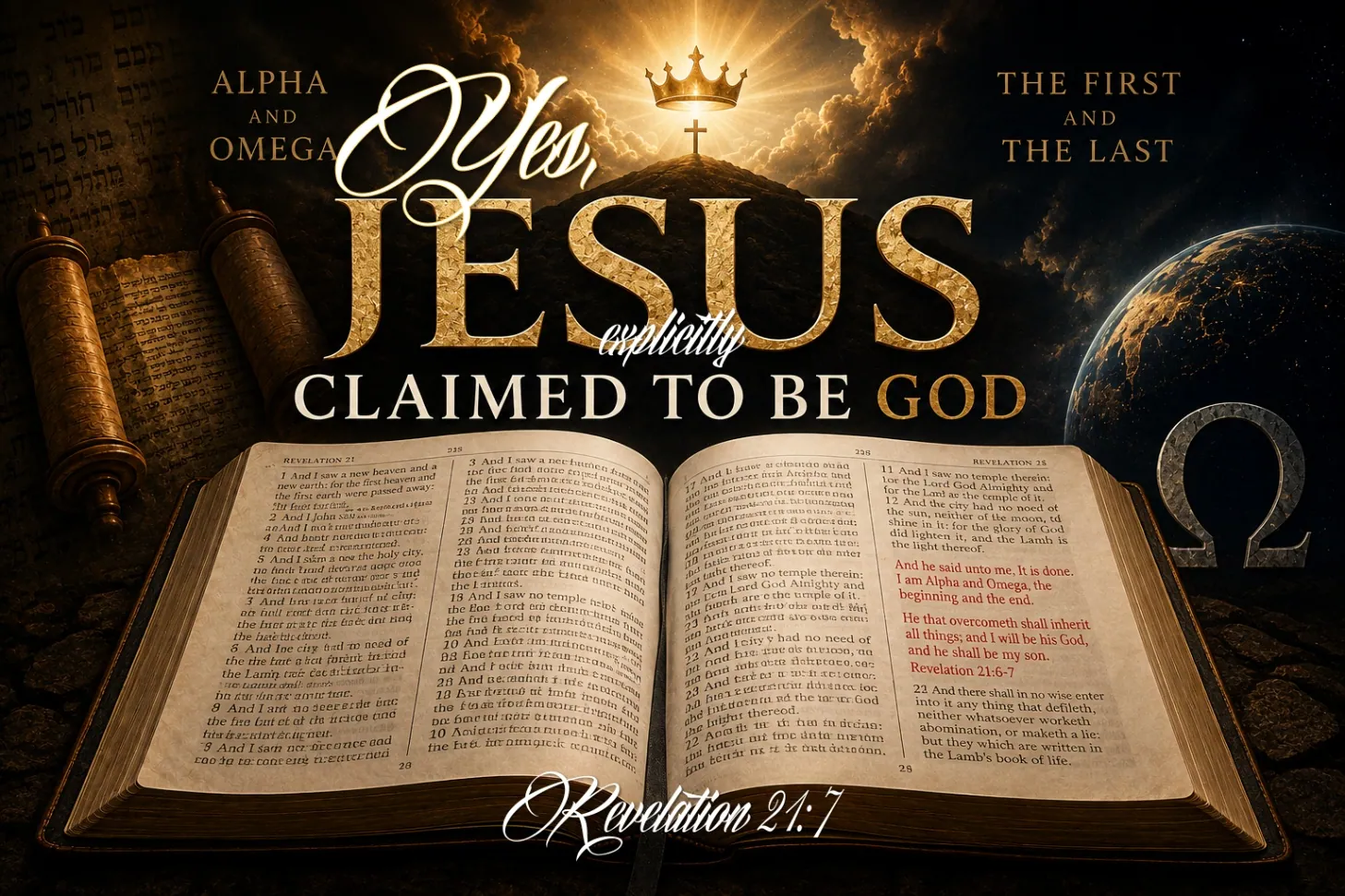
One of the most common arguments raised against the deity of Jesus Christ is surprisingly simple:
“Jesus never claimed to be God.”
Skeptics, Muslims, Unitarians, and others who deny the full deity of Christ repeat this statement constantly. More troubling is that almost everyone within our own Oneness churches are unable to answer it clearly. They know many Scriptures proving that Jesus is God, yet when someone asks, “Where did Jesus Himself actually claim to be God?” they often struggle. They may point to passages where Isaiah, John, Paul, Thomas, or someone else identifies Jesus as God, but they cannot produce the passage where Jesus Himself explicitly makes that claim.
Those Scriptures are important. They overwhelmingly establish the deity of Christ. But they do not completely answer the particular challenge being made.
Isaiah can call Him God. Thomas can call Him God. Paul can declare that all the fullness of the Godhead dwells bodily in Him. John can declare that the Word was God and became flesh. All of those passages prove His deity. But the question remains more specific:
Did Jesus Himself ever claim to be God?
The answer is yes.
In red letters?
Yes!
Although some bibles put it in black lettering, attempting to rob Jesus of his rightful claim to deity. But we will debunk the black letter styling with conclusive evidence that Jesus explicitly claimed to be God and the letters rightfully should be printed in red.
Before we come to the one place where Jesus makes that claim explicitly, however, we should first recognize the overwhelming testimony surrounding His identity. Throughout Scripture, Jesus repeatedly claims the names, titles, authority, works, worship, and prerogatives belonging to God alone.
The Bible Overwhelmingly Identifies Jesus as God
Hundreds of years before the birth of Christ, Isaiah prophesied:
“For unto us a child is born, unto us a son is given: and the government shall be upon his shoulder: and his name shall be called Wonderful, Counsellor, The mighty God, The everlasting Father, The Prince of Peace.”
The child who would be born and the Son who would be given would be called The mighty God and The everlasting Father.
John begins his Gospel with an equally unmistakable declaration:
“In the beginning was the Word, and the Word was with God, and the Word was God.”
He then tells us what happened to that Word:
“And the Word was made flesh, and dwelt among us...”
Paul writes concerning Jesus Christ:
“For in him dwelleth all the fulness of the Godhead bodily.”
Not part of the Godhead. Not one-third of the Godhead. All the fulness of the Godhead bodily.
These passages already make the deity of Christ unmistakable. But Jesus Himself repeatedly said and did things that His own hearers understood as divine claims.
“Before Abraham Was, I Am”
Jesus told the Jews:
“Verily, verily, I say unto you, Before Abraham was, I am.”
Their reaction was immediate:
“Then took they up stones to cast at him...”
They understood that Jesus had made a claim far greater than merely saying He existed before Abraham. His language identified Him with the divine I AM.
“I and My Father Are One”
Jesus later declared:
“I and my Father are one.”
Again, His hearers immediately reached for stones.
“Then the Jews took up stones again to stone him.”
Jesus asked them why, and they answered:
“For a good work we stone thee not; but for blasphemy; and because that thou, being a man, makest thyself God.”
That statement is extraordinarily important.
Jesus' enemies understood what many modern readers attempt to explain away: He was making Himself God.
They were not attempting to execute Him because He merely claimed to agree with God. They accused Him of blasphemy because they understood the magnitude of His claim.
“He That Hath Seen Me Hath Seen the Father”
Philip once asked Jesus:
“Lord, shew us the Father, and it sufficeth us.”
Jesus answered:
“Have I been so long time with you, and yet hast thou not known me, Philip? he that hath seen me hath seen the Father...”
Then He explained:
“The Father that dwelleth in me, he doeth the works.”
Jesus did not point Philip somewhere else to find the Father. He told him that seeing Him was seeing the Father revealed and that the Father dwelt within Him.
Jesus Claimed the Authority to Forgive Sins
When the man sick of the palsy was brought before Jesus, Jesus first said:
“Son, thy sins be forgiven thee.”
The scribes immediately objected:
“Who can forgive sins but God only?”
Notice that Jesus did not correct their underlying premise.
Instead, He demonstrated that He possessed precisely that authority:
“But that ye may know that the Son of man hath power on earth to forgive sins...”
He then healed the man.
The issue was greater than healing. Jesus publicly exercised an authority His hearers recognized as belonging to God alone.
Jesus Declared Himself Lord of the Sabbath
Jesus also said:
“Therefore the Son of man is Lord also of the sabbath.”
The Sabbath did not originate with a rabbi, priest, prophet, or king. It was rooted in God's own work of creation and later incorporated into Israel's covenant.
Jesus did not merely claim to understand the Sabbath better than the Pharisees.
He declared Himself Lord of it.
That is an astonishing claim of authority over something established by God Himself at creation.
Jesus Accepted Worship
Jesus was not merely worshipped once in an unusual circumstance. Throughout the New Testament, He repeatedly receives worship without rebuking those who give it. In the Gospel record alone, there are numerous explicit occasions—commonly counted at least thirteen—where people worship Jesus.
The wise men:
“fell down, and worshipped him.”
A leper:
“came and worshipped him.”
Jairus:
“came a certain ruler, and worshipped him.”
After Jesus walked upon the sea:
“Then they that were in the ship came and worshipped him, saying, Of a truth thou art the Son of God.”
The woman of Canaan:
“Then came she and worshipped him...”
After His resurrection:
“They came and held him by the feet, and worshipped him.”
And again:
“And when they saw him, they worshipped him...”
Thomas stood before the risen Christ and declared:
“My Lord and my God.”
Jesus did not correct him.
That becomes especially significant when compared with how God's servants respond when someone attempts to worship them. When Cornelius fell at Peter's feet:
“Peter took him up, saying, Stand up; I myself also am a man.”
When John attempted to worship an angel, the angel immediately stopped him:
“See thou do it not... worship God.”
Jesus never responded that way.
He repeatedly accepted worship.
Jesus Even Defended the Worship Given to Him
One of the strongest examples occurred when Jesus entered Jerusalem.
The multitude praised Him openly:
“Blessed be the King that cometh in the name of the Lord: peace in heaven, and glory in the highest.”
The Pharisees objected:
“Master, rebuke thy disciples.”
Jesus could have corrected the multitude.
He could have said, “Do not praise me.”
He could have redirected their worship.
Instead He answered:
“I tell you that, if these should hold their peace, the stones would immediately cry out.”
Jesus did not merely tolerate their praise.
He defended it.
He declared that if the people ceased praising Him, creation itself would cry out.
The contrast could hardly be stronger. Angels reject worship. Apostles reject worship. Jesus receives it—and when religious leaders demand that He stop it, He declares that the stones themselves would take up the praise.
Yet One Question Still Remains
All of this demonstrates the deity of Christ.
Jesus claimed divine titles.
He exercised divine authority.
He forgave sins.
He declared Himself Lord of the Sabbath.
He said that seeing Him was seeing the Father.
His enemies understood Him to be making Himself God.
He repeatedly accepted worship and even defended the worship given to Him.
But someone can still ask:
“Where did Jesus actually say that He Himself is God?”
Now we come to the answer.
Who Is the Alpha and Omega?
In Revelation, someone repeatedly identifies Himself using titles belonging to God.
At the very beginning we read:
“I am Alpha and Omega, the beginning and the ending, saith the Lord, which is, and which was, and which is to come, the Almighty.”
Again:
“I am Alpha and Omega, the first and the last...”
John then turns to see the Person speaking:
“And I turned to see the voice that spake with me...”
What does he see?
“And in the midst of the seven candlesticks one like unto the Son of man...”
John describes His eyes like a flame of fire, His feet like fine brass, His voice like many waters, and His countenance shining as the sun in its strength.
John falls before Him as dead.
Then the speaker identifies Himself:
“Fear not; I am the first and the last: I am he that liveth, and was dead; and, behold, I am alive for evermore...”
Who was dead and is now alive forevermore?
Jesus Christ.
Jesus is the Son of Man.
Jesus died.
Jesus rose from the dead.
Jesus lives forevermore.
Therefore the One identifying Himself as the First and the Last is Jesus Christ.
Then Jesus Says It Explicitly
Now we reach the passage that directly answers the entire objection.
The same Alpha and Omega speaks again near the end of Revelation:
“And he said unto me, It is done. I am Alpha and Omega, the beginning and the end.”
Then the speaker continues:
“He that overcometh shall inherit all things; and I will be his God, and he shall be my son.”
Read those words carefully.
He does not say:
God will be his God.
He says:
This is not Isaiah calling Jesus God.
This is not John explaining that the Word is God.
This is not Paul saying that the fullness of the Godhead dwells in Christ.
This is not Thomas crying, “My Lord and my God.”
This is the speaker identifying Himself:
“I will be his God.”
And who is the speaker?
The Alpha and Omega.
The First and the Last.
The One who was dead and is alive forevermore.
Jesus Christ.
This is the explicit claim so many Christians cannot find when challenged.
Jesus Himself says:
“I will be his God.”
Revelation 22 Removes Any Remaining Doubt
The same speaker continues in the final chapter:
“And, behold, I come quickly; and my reward is with me, to give every man according as his work shall be.”
Then:
“I am Alpha and Omega, the beginning and the end, the first and the last.”
Only a few verses later, the speaker identifies Himself by name:
“I Jesus have sent mine angel to testify unto you these things in the churches.”
The chain is complete.
The Alpha and Omega is Jesus.
The First and the Last is Jesus.
The One who was dead and lives forevermore is Jesus.
The One who is coming quickly is Jesus.
And the One who says:
“I will be his God”
is Jesus.
The Final Knockout: “The Lord... The Almighty”
Now return to where Revelation began:
“I am Alpha and Omega, the beginning and the ending, saith the Lord, which is, and which was, and which is to come, the Almighty.”
Follow the identification through Revelation itself.
Alpha and Omega.
The First and the Last.
The One who was dead and lives forevermore.
The One who comes quickly.
“I Jesus.”
And Revelation 1:8 calls the Alpha and Omega:
“the Lord... the Almighty.”
Then Revelation 21:7 records the same divine speaker declaring:
“I will be his God.”
The testimony is cumulative and overwhelming.
Jesus claimed God's names.
Jesus claimed God's authority.
Jesus exercised God's prerogative to forgive sins.
Jesus declared Himself Lord of the Sabbath.
Jesus said that seeing Him was seeing the Father.
Jesus accepted worship repeatedly.
Jesus defended the worship given to Him.
His enemies understood Him to be making Himself God.
Jesus identified Himself as the First and the Last.
Jesus identified Himself as Alpha and Omega.
Jesus identified Himself as the One who was dead and now lives forevermore.
Jesus is identified with “the Lord... the Almighty.”
And finally Jesus Himself declared:
“I will be his God.”
So when someone says:
“Jesus never claimed to be God,”
the Christian should never again be left searching helplessly for an answer.
The Bible does not merely imply that Jesus is God.
Other people do not merely call Him God.
Jesus Himself claimed it.
And the final question is no longer whether Jesus claimed to be God.
The question is whether we are willing to believe what He said.