
As Taught by Jesus and the Apostles
Introduction
Some of the most common questions asked in the Apostolic Church today concern Bible prophecy: Is the Rapture pre-tribulation, mid-tribulation, or post-tribulation? Who is the Antichrist? What is the Mark of the Beast? What is the Millennium? These are not minor questions. They shape how believers understand the return of Jesus Christ, the resurrection, the final judgment, and the end of time.
At The Present Kingdom (www.thepresentkingdom.com), we address these important eschatological subjects from the historic Apostolic teachings of Jesus and the Apostles, rather than from modern prophetic systems inherited from later Trinitarian theologians. In this study, we will examine the doctrine of the Rapture directly from Scripture—and what you will see is very different from what is commonly being taught today.
There is much confusion surrounding these subjects, but that confusion does not come from Scripture. Modern prophetic systems have separated things the Bible places together and combined things that have little or no relationship to one another. The result is confusion that Scripture itself does not create.
In fact, Scripture provides its own hermeneutical principles and integrated systems for understanding prophecy—principles that are often neither recognized nor applied. God is not the author of confusion, and He has given us the means to understand what He has revealed.
Clear Scriptures must first be assembled and allowed to establish the doctrine definitively; only then should vague or disputed passages be tested to determine whether they even apply, and if they do, whether they clarify the established picture, modify a secondary detail, or have no relevance to it at all.
One clear example is the deity of Jesus Christ. The New Testament establishes Christ’s deity repeatedly, across many books, authors, and lines of argument, so the doctrine is not built on one isolated or ambiguous verse. The cumulative teaching is clear: Jesus Christ is God.
When other passages emphasize His humanity—His hunger, suffering, prayer, growth, temptation, death, or submission—we do not use those verses to cancel or weaken the passages establishing His deity. We reconcile the whole testimony of Scripture: Jesus Christ was fully God and fully man. Clear doctrine is established by the full body of Scripture; individual passages are then understood in harmony with that established truth, not used to overturn it. This is exactly how we approach the question of the rapture in this study.
When we allow Scripture to interpret Scripture, use the clear biblical markers supplied by the text itself, and keep together the events the Bible places together, the outcome is clear. The pieces fit, the chronology becomes coherent, and the confusion disappears.
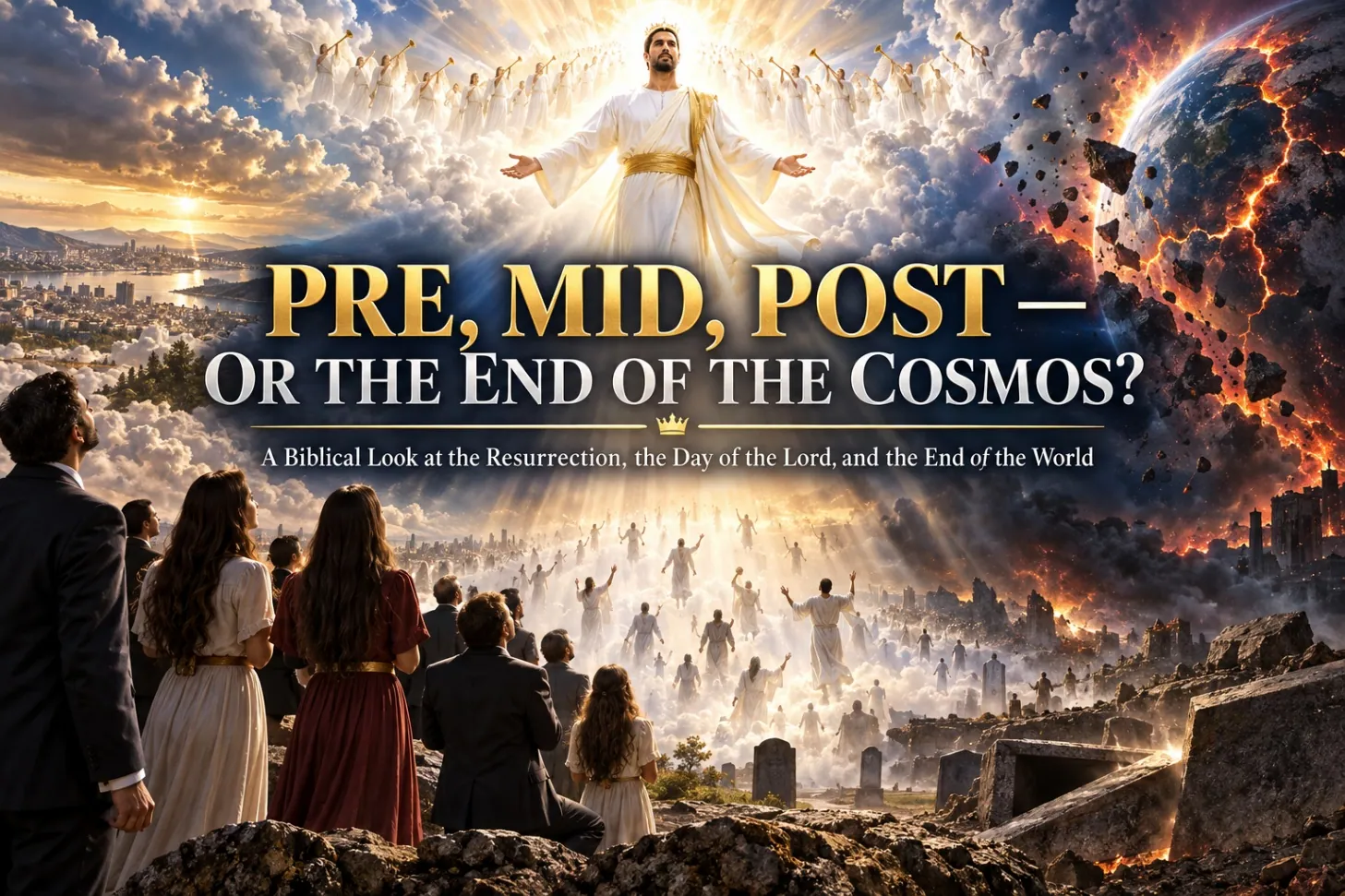
Pre, Mid, Post — or the End of the Cosmos?
The debate over the “rapture” is usually framed as pre-trib, mid-trib, or post-trib.
But there is another question that may be far more important:
WHAT IF THE RAPTURE OCCURS AT THE END OF THE COSMOS?
There can be no denying that 1 Thessalonians 4:16–17 is the passage most commonly identified with the rapture:
📜 “For the Lord himself shall descend from heaven with a shout… and the dead in Christ shall rise first: Then we which are alive and remain shall be caught up together with them…”
But Paul’s discussion of the subject does not end when chapter 4 ends.
The chapter divisions were added later.
Paul continues:
📜 “But of the times and the seasons, brethren, ye have no need that I write unto you. For yourselves know perfectly that the DAY OF THE LORD so cometh as a thief in the night.”
The catching away of the saints, the resurrection of the dead, and the Day of the Lord belong to the same continuing discussion and topic.
Paul does not introduce a new event in chapter 5; after describing the Lord’s descent, the resurrection, and the catching away, he immediately turns to “the times and the seasons” of that very event and identifies it as “the DAY OF THE LORD” (1 Thess. 5:1–2).
He even carries the same conclusion forward: chapter 4 ends with the saints “and so shall we ever be with the Lord” (4:17), and chapter 5 says that whether we “wake or sleep, we should live together with him” (5:10). Paul is describing one continuous event across chapter boundaries: Christ comes, the dead are raised, the living are caught up, and the Day of the Lord arrives.
And Peter tells us exactly what happens on that Day.
The Day of the Lord Ends the Present Creation
Peter warns:
📜 “There shall come in the last days scoffers… Saying, Where is the promise of his coming?... all things continue as they were from the beginning of the creation.”
The scoffers’ argument is essentially:
Nothing has happened.
There has been no rapture.
No secret catching-away.
No second coming.
No apocalyptic event whatsoever.
Everything continues as before.
But Peter says that’s going to change with the next major event. The Day of the Lord is coming:
📜 “But the DAY OF THE LORD will come as a thief in the night; in the which the HEAVENS SHALL PASS AWAY with a great noise, and the elements shall melt with fervent heat, the EARTH ALSO and the works that are therein SHALL BE BURNED UP.”
That is staggering.
Paul says the resurrection and catching away occur at the Day of the Lord.
Peter says the Day of the Lord is when:
THE HEAVENS PASS AWAY.
THE ELEMENTS MELT.
THE EARTH IS BURNED.
Then Peter says:
📜 “Nevertheless WE, according to his promise, look for NEW HEAVENS AND A NEW EARTH…”
Peter is writing to the church: “we”. Although Peter did not know the day or the hour, he is warning the church that the Day of the Lord is coming — so be ready. The church will see it.
📜 “Wherefore, beloved, seeing that ye look for such things, be diligent that ye may be found of him in peace, without spot, and blameless.”
📜“Beloved” — the church is the audience; you and I. “…seeing that YE look for such thingS.”
And
📜But the end of all things is at hand: be ye therefore sober, and watch unto prayer.
To the church: “YE.” The same church that exists today. “the end of all things is at hand.”
With the same expectation: The end of all things is at hand.
We know this is written to us because no cataclysmic event has happened since this was written. This is why the scoffers are mocking. Nothing has happened. Peter said to look for the “Day of the Lord” — to look for the resurrection, the coming of the Lord, and the destruction of the cosmos.
So perhaps the real timing question is not:
PRE?
MID?
POST?
Perhaps the biblical answer is:
THE END.
Jesus Put the Harvest at the End of the World
Speaking of the wheat (believers) and tares (unbelievers), Jesus said:
📜 Let both grow together until the harvest: and in the time of harvest I will say to the reapers, Gather ye together first the tares… to burn them: but gather the wheat into my barn.
Jesus didn’t allow for any separation of time. “Let both grow together until the harvest.”
Then:
“The harvest is the END OF THE WORLD.”
— Matthew 13:39
At that harvest both wheat and tares are dealt with.
Not seven years before the end.
Not a secret gathering followed by another age.
THE END OF THE WORLD.
Paul Places the Resurrection at Christ’s Coming — Then the End
Paul writes:
📜 “For since by man came death, by man came also the resurrection of the dead.”
Then he gives the order:
📜 “Christ the firstfruits; afterward they that are Christ’s AT HIS COMING. THEN COMETH THE END.”
Paul did not say, then cometh the beginning, or the beginning of a new 1,000-year millennial era, or even the beginning of the Great Tribulation. He said, then cometh the end. The Tribulation and millennial reign are over, not beginning.
Also of great importance to the context, Paul speaks of the resurrection sequence: Christ — then those that are Christ’s — at His coming. No others.
The full sequence is remarkably simple:
CHRIST COMES.
HIS PEOPLE ARE RAISED.
THEN COMETH THE END.
Jesus Said “The Last Day” Four Times
John 6 may be the most difficult passage of all for any system placing the resurrection years before the end.
Jesus says:
📜 “I will raise him up again at the LAST DAY.”
Again:
📜 “I will raise him up at the LAST DAY.”
Again:
📜 “I will raise him up at the LAST DAY.”
And again:
📜 “I will raise him up at the LAST DAY.”
Four times.
Not:
seven years before the last day.
Not:
before a future thousand-year earthly age.
Jesus said:
THE LAST DAY.
This must be a different, later resurrection, right?
No. Jesus said, “EVERY ONE WHICH SEETH THE SON, and BELIEVETH ON HIM… I will raise him up at the LAST DAY.”
There are not two separate bodily resurrections—one for Israel and another for the Church. Lazarus was a Jew of the Old Covenant people, yet Martha expected him to rise also in the same resurrection that Jesus repeatedly places at the last day for EVERYONE that believes in Him.
📜 “I know that he shall rise again in the resurrection at the last day.”
Daniel Places Resurrection at the Final Deliverance
Daniel describes the great final trouble:
📜 “There shall be a time of trouble, such as never was since there was a nation…”
Then immediately:
📜 “And many of them that sleep in the dust of the earth shall awake, some to everlasting life, and some to shame and everlasting contempt.”
Trouble.
Deliverance.
Resurrection.
Final judgment.
Again, the resurrection is positioned at the climax.
The Clear Passages Must Establish the Foundation
Up to this point, Jesus, Paul, Peter, Matthew, and John have all spoken with direct, explicit language about the resurrection, the coming of Christ, the Day of the Lord, the judgment, and the end of the world. The statements are simple. The boundaries are clear. The chronology is not vague. All describe a singular, final event. These are exactly the kinds of definitive passages that must establish the foundation of doctrine.
If there were only one or two of these clear statements, there might be room to argue that some external context changes how they should be understood. But taken together, they form a powerful and consistent biblical foundation. Yet all of these direct statements are repeatedly reversed, weakened, or explained away on the basis of isolated phrases such as “we are not appointed to wrath” or clichés like “God would not bash His bride.” Clear, repeated Scripture should not be overturned by assumptions that are imposed upon the text. That is a complete reversal of sound biblical interpretation. Clear Scripture establishes the doctrine; difficult, vague, or disputed passages must be interpreted in harmony with that clear foundation—not used to overthrow it.
The common approach to discrediting Jesus’ “end of the world” and Paul’s “the end” is to claim that Jesus did not really mean the end of the world, and Paul did not really mean the end. Jesus supposedly did not really mean “the last day,” and neither did Martha; instead, they supposedly meant 1,007 years before the last day. Peter did not really mean “the end of all things.” The Day of the Lord is supposedly not ONE day, but instead 1,000 years. Paul’s “last trumpet” is supposedly not the last trumpet. The seventh trumpet in Revelation—which ushers in the end of time, the fulfillment of all prophecy, and the finishing of the mystery of God—is supposedly not the end of time, not the fulfillment of all prophecy, and the mystery of God is somehow not finished. Furthermore, Daniel’s resurrection of everyone found written in the book at the time of the final judgment supposedly includes only SOME of those written in the book, because there was allegedly an earlier resurrection that already included others whose names were also written in the book. And perhaps one of the most egregious claims is that Jesus coming as a thief and Jesus coming as a thief in the night are not the same coming. The plain language of Scripture is tortured in order to preserve a pre-tribulation rapture and a future earthly millennium—doctrines the Bible never actually states. Scripture repeatedly speaks of THE coming of Christ, not multiple future comings manufactured to make a theological system work.
The New Testament refers to Jesus coming—using the forms come, coming, cometh, and comes—49 times in 47 verses, and these references consistently point to one singular coming, with overlapping terminology, common characteristics, and converging timelines.
It is structurally impossible to separate the text of these 49 references into multiple future comings without breaking the network of overlapping characteristics that connects them. The same resurrection, gathering of the saints, judgment, Day of the Lord, last day, trumpet, appearing, and end of the world repeatedly intersect across these passages, binding them together as one singular coming of Jesus Christ.
We acknowledge that Dispensationalists do cite certain Scriptures in support of their position. The problem is that these are not separate pre-tribulation or premillennial passages. They are passages describing the Second Coming, the resurrection, the judgment, the Day of the Lord, and the end of the world that have been separated from their surrounding context and reassigned to different supposed events in order to create a different eschatological system.
So What Does the Bible Actually Show?
Put the passages together:
PEOPLE ARE MOCKING. NOTHING HAS HAPPENED — JESUS, HIS RETURN, AND THE BIBLE ARE ALL A ‘HOAX’.
— 2 Peter 3:3–4
THE LORD DESCENDS.
— 1 Thessalonians 4
THE DEAD IN CHRIST RISE.
— 1 Thessalonians 4
THE LIVING SAINTS ARE CAUGHT UP.
— 1 Thessalonians 4
THE DAY OF THE LORD ARRIVES.
— 1 Thessalonians 5
THE HEAVENS PASS AWAY.
— 2 Peter 3
THE EARTH IS BURNED.
— 2 Peter 3
THE HARVEST OCCURS AT THE END OF THE WORLD.
— Matthew 13
THOSE WHO ARE CHRIST’S ARE RAISED AT HIS COMING.
— 1 Corinthians 15
THEN COMETH THE END.
— 1 Corinthians 15
THE DEAD AWAKE TO LIFE OR JUDGMENT.
— Daniel 12
And Jesus says four times:
“I WILL RAISE HIM UP AT THE LAST DAY.”
So perhaps Christians have spent too much time debating whether the rapture is pre, mid, or post tribulation.
The more fundamental biblical question is:
WHAT IF THE RESURRECTION AND CATCHING AWAY OCCUR EXACTLY WHERE JESUS SAID THEY WOULD—AT THE LAST DAY?
Because when Paul’s “rapture passage” is allowed to continue into the Day of the Lord, and Peter is allowed to tell us what that Day actually does, the destination is not another earthly age.
IT IS THE END OF THE PRESENT COSMOS.
But What About Revelation 20 and the Millennium?
This objection actually collapses when Revelation 20 is read with the rest of Scripture.
John says:
📜 “I saw the souls of them that were beheaded… and they lived and reigned with Christ a thousand years.”
This is the church — the saints reigning with Christ as kings and priests during the thousand-year present kingdom that Jesus established at His first coming (Matt. 6:30; Matt. 10:7; Matt. 12:28; Luke 17:20–21; Rom. 14:17). Nothing here says they were resurrected or reigned before the millennium, and nothing says that each individual reigns for a full thousand years. Rather, the Church as a whole reigns with Christ throughout the thousand years. They live and die, but will all be resurrected at the end of the 1,000 years in the FIRST RESURRECTION.
Then John says:
📜 “But the rest of the dead lived not again until the thousand years were finished. This is the first resurrection.”
The proper interpretation of Revelation 20:4–6, which rejects imported assumptions and aligns with biblical continuity on the subject, is as follows.
Revelation 20:4–6 — The First Resurrection After the Thousand Years
Revelation 20:4 describes the people of God reigning with Christ during the thousand years, including those who are killed during the Great Tribulation. The passage does not say that the First Resurrection occurred before the thousand years. The Church as a whole reigns with Christ throughout this millennial period, even though individual believers live and die at different points within it.
Verse 5 then gives the critical chronological marker:
“But the rest of the dead lived not again until the thousand years were finished. This is the first resurrection.”
Who are “the rest of the dead”? They cannot simply be identified as the wicked, because the righteous dead who lived before the Church age—including the Old Testament saints—must also participate in the First Resurrection. Daniel places God's people who are “found written in the book” at the resurrection when those sleeping in the dust awake (Dan. 12:1–2). Therefore, righteous dead remain among the dead awaiting resurrection until the thousand years are finished.
Verse 6 then describes those who participate in that resurrection:
“Blessed and holy is he that hath part in the first resurrection: on such the second death hath no power…”
The Old Testament saints must be included in that First Resurrection, yet they obviously were not the Great-Tribulation martyrs described in verse 4. Therefore verse 4 cannot be describing a resurrection that occurred before the millennium or the Old Testament saints would be alive with us today. The First Resurrection occurs when the thousand years are finished—exactly where the rest of Scripture places it: at the Last Day and the coming of Christ.
The sequence is therefore straightforward:
VERSE 4 — GOD'S PEOPLE REIGNING WITH CHRIST LIVE AND DIE DURING THE THOUSAND YEARS.
VERSE 5 — THESE DEAD, ALONG WITH THE REST OF THE DEAD, LIVE AGAIN WHEN THE THOUSAND YEARS ARE FINISHED.
VERSE 6 — THOSE WHO PARTICIPATE IN THIS FIRST RESURRECTION ARE BLESSED AND HOLY.
THE BIBLE SPEAKS OF NO RESURRECTION BEFORE OR AFTER THE FIRST RESURRECTION — ONLY THE RESURRECTION OF THE JUST AND THE UNJUST, WHICH THE BIBLE CONSISTENTLY DEFINES AS A SINGLE EVENT.
The idea of a bodily resurrection before the thousand years is not what Scripture teaches. It is an interpretation imposed upon Revelation 20 that contradicts the unmistakable resurrection chronology everywhere else in the Bible.
Jesus says:
📜 “ALL that are in the graves shall hear his voice, And shall come forth…”
Both righteous and wicked.
Daniel says:
📜 “Many of them that sleep in the dust of the earth shall awake, some to everlasting life, and some to shame…”
Paul says:
📜 “There shall be A RESURRECTION of the dead, both of the just and unjust.”
Jesus says four times:
📜 “I will raise him up at the LAST DAY.”
And Jesus places the final separation of the righteous and wicked at His coming:
📜 “When the Son of man shall come in his glory… then shall he sit upon the throne of his glory: And before him shall be gathered all nations: and he shall separate them one from another, as a shepherd divideth his sheep from the goats.”
The passage ends with both groups receiving their final destiny:
📜 “And these shall go away into everlasting punishment: but the righteous into life eternal.”
So Jesus places the resurrection at the LAST DAY and the final judgment of the righteous and wicked at His coming.
And Paul gives the order:
📜 “They that are Christ’s AT HIS COMING. THEN COMETH THE END.”
So Scripture does not give us:
RESURRECTION OF THE RIGHTEOUS
then 1,000 YEARS
then RESURRECTION OF THE WICKED
It gives us:
THE MILLENNIUM
↓
THE LAST DAY
↓
CHRIST RETURNS
↓
THE RESURRECTION OF THE JUST AND UNJUST
↓
THEN COMETH THE END
The interpretation that places a bodily resurrection before the thousand years is wrong because it contradicts the clear testimony of Jesus, Daniel, Paul, and the rest of Scripture.
Revelation 20 must agree with the Bible.
And the Bible places the resurrection:
AFTER THE MILLENNIUM.
AT THE LAST DAY.
AT THE COMING OF CHRIST.
AT THE END OF THE WORLD.
We affirm that the evidence presented in this Bible study establishes a sound hermeneutical case for the thesis that the Rapture occurs at the end of the world. There are no Scriptures or passages—if any exist at all—that carry sufficient textual or hermeneutical weight to overturn the case presented here.
It should also be noted that there are many additional passages throughout Scripture—primarily in the New Testament, but also in the Old Testament—that support this singular climactic event identified as the Day of the Lord. This article has been intentionally shortened for clarity and is not intended to be exhaustive. For those who truly want to go deeper into the subject, The Present Kingdom contains additional Bible studies that examine other passages and the broader prophetic framework in much greater detail.