Personality Worship, Blind Allegiance, and the Corinthian Rebuke of Modern Church Culture
Original work and inspiration by friend and beloved brother in Christ, Barry Grogan
Introduction
Paul’s letters to the Corinthians expose a problem that has never disappeared from the church: believers becoming overly attached to personalities, ministers, titles, reputations, and human authority.
The Corinthian church was spiritually gifted, but it was also deeply vulnerable to personality worship. Paul confronted this immediately in his first letter:
“I beseech you, brethren… that there be no divisions among you.”
He then identified the source of those divisions:
“Every one of you saith, I am of Paul; and I of Apollos; and I of Cephas; and I of Christ.”
Paul did not commend them for having favorite ministers. He rebuked them.
Their attachment to particular men had become so strong that they were dividing the body of Christ around ministerial personalities.
Paul answered with three devastating questions:
“Is Christ divided? was Paul crucified for you? or were ye baptized in the name of Paul?”
The answer to every question was obvious.
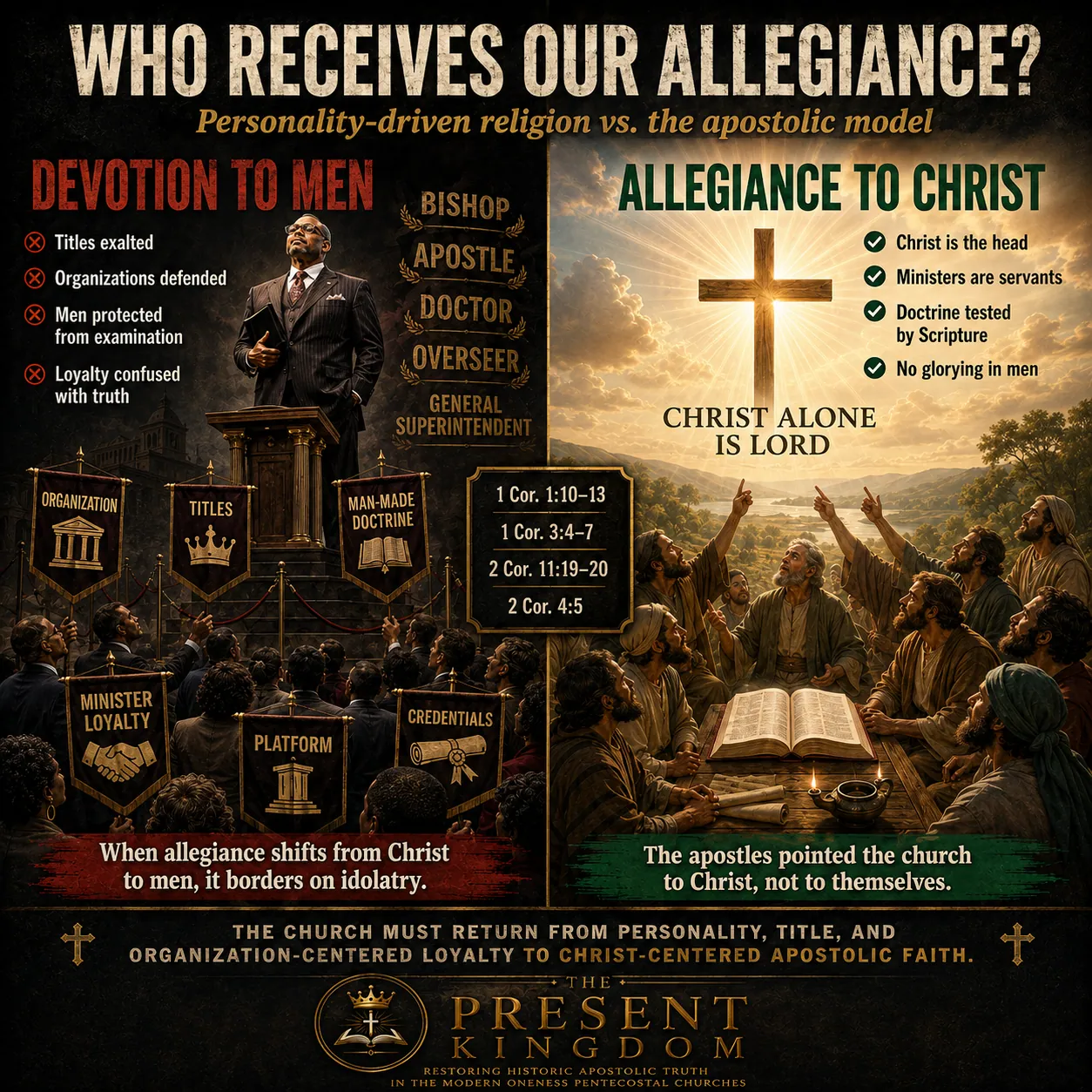
The moment believers begin identifying themselves by a particular minister, personality, fellowship, or organization, a spirit of division is introduced. The very distinction separates one group from another and can quickly produce thoughts of superiority, inferiority, doctrinal exclusivity, or competing loyalties. People begin to feel compelled to take sides, defend their group, oppose another, distrust those outside it, or even disfellowship believers whose primary offense is that they belong to a different personality or organization. Paul recognized that this kind of identity-making fractures the body of Christ before the argument has even begun.
No minister died for the church.
No preacher purchased the church with his blood.
No organization is the body of Christ.
No pastor is the head of the church.
Christ is.
And when believers attach their spiritual identity to men, ministries, fellowships, organizations, or personalities, they begin giving human servants a place that belongs only to Jesus Christ.
1. “I Am of Paul” Is Still Alive
The names have changed. The problem has not. Today people may not say:
“I am of Paul.”
“I am of Apollos.”
“I am of Cephas.”
But they say the same thing in different language.
“I am with this ministry.”
“I follow this preacher.”
“My pastor says…”
“Our organization teaches…”
“That man could never be wrong.”
“That ministry has always stood for truth.”
And sometimes the strongest defense of a doctrine is not Scripture at all. It is:
“Brother So-and-So taught it.”
Paul would not have accepted that.
In fact, Paul later told the Corinthians exactly what their ministerial obsession revealed:
“For while one saith, I am of Paul; and another, I am of Apollos; are ye not carnal?”
That is stronger than most modern preaching on the subject. Paul called personality-based Christianity carnality. Why? Because it replaces spiritual discernment with human attachment.
It causes believers to judge truth by who said it rather than by whether Scripture says it.
It creates divided authorities. It creates divided loyalty circles. It creates untouchable leaders.
And eventually it becomes possible for people to defend a man even when Scripture should be causing them to examine him. Paul refused to participate in that system. He asked:
“Who then is Paul, and who is Apollos, but ministers by whom ye believed…?”
Ministers. That word matters:
Ministers.
Servants.
Not celebrities.
Not kings.
Not spiritual aristocracy.
Not men whose personalities should become the identity of the church.
Paul planted.
Apollos watered.
But:
“God gave the increase.”
The minister is never the source.
God is.
2. The “Super Apostles”
By the time Paul wrote his second letter to Corinth, the problem had become even worse.
The Corinthians had become fascinated with powerful religious personalities who presented themselves as superior apostles.
Paul referred to these men sarcastically:
“the very chiefest apostles”
The expression is often rendered in modern translations as “super-apostles.” Paul was not honoring them. He was mocking their self-importance.
These men apparently possessed the qualities religious audiences often admire:
confidence,
eloquence,
credentials,
authority,
self-promotion,
impressive claims,
and the ability to dominate people.
The Corinthians were enamored with them. And Paul’s rebuke is astonishing:
“For ye suffer fools gladly, seeing ye yourselves are wise.”
Then he describes exactly what they were tolerating:
“For ye suffer, if a man bring you into bondage, if a man devour you, if a man take of you, if a man exalt himself, if a man smite you on the face.”
Notice that Paul does not rebuke only the abusive leaders.
He rebukes the church for allowing them.
“You suffer it.”
You tolerate it.
You submit to it.
You excuse it.
You make room for it.
That makes this passage extraordinarily relevant to the modern church.
A domineering minister cannot build a personality cult by himself. People have to cooperate with it.
They have to surrender discernment.
They have to excuse behavior.
They have to treat questioning as rebellion.
They have to defend what Scripture would condemn.
And eventually loyalty to the leader becomes confused with loyalty to God. Paul refuses that confusion completely.
3. Paul’s Credentials Looked Nothing Like Theirs
The irony is that Paul actually possessed apostolic authority. Yet when he finally listed his credentials, they did not look like the credentials of religious celebrity. He wrote of:
imprisonments,
beatings,
shipwrecks,
danger,
hunger,
thirst,
weariness,
pain,
persecution,
and continual concern for the churches.
See 2 Corinthians 11:23–28.
The “super-apostles” apparently gloried in strength.
Paul gloried in weakness.
They exalted themselves.
Paul exposed himself.
They used credentials to elevate their position.
Paul used his suffering to show what genuine ministry had cost him.
“My grace is sufficient for thee: for my strength is made perfect in weakness.”
That completely overturns the modern religious fascination with image.
The world says:
Build the platform.
Promote the brand.
Display your success.
Protect your reputation.
Show people your influence.
Prove your importance.
Paul says:
“Most gladly therefore will I rather glory in my infirmities, that the power of Christ may rest upon me.”
The true minister does not need to convince the church that he is great. He needs the church to see that Christ is great. Paul’s résumé ends with a burden no title could manufacture: “that which cometh upon me daily, the care of all the churches” (2 Corinthians 11:28). Modern religious résumés often emphasize offices held, platforms reached, crowds addressed, education, connections, and public recognition. Paul emphasized what ministry had cost him. His evidence of calling was not how many people served him, but how much he had spent himself serving them.
4. The Church Has Learned to Excuse What Paul Condemned
The Corinthian problem bears an uncomfortable resemblance to modern Christianity.
We have become comfortable with religious celebrity.
We create conferences around personalities.
We build audiences around personalities.
We attach ministries to personalities.
We defend personalities.
We excuse personalities.
We sometimes measure spiritual authority by:
church size,
social-media following,
organizational title,
speaking schedule,
education,
family name,
years in ministry,
connections,
wealth,
or platform.
None of those things proves apostolic character.
A man may preach to ten thousand people and still be wrong.
A man may hold the highest title in an organization and still require correction.
A man may possess extraordinary charisma and still be spiritually dangerous.
A man may have fifty years in ministry and still teach tradition instead of Scripture.
Paul’s question still stands:
“For who maketh thee to differ from another? and what hast thou that thou didst not receive?”
Everything a minister possesses came from God.
Gift.
Opportunity.
Knowledge.
Influence.
Ability.
Breath.
Life.
So where is the ground for self-exaltation?
There is none.
5. Loyalty Is Not the Same Thing as Blindness
Modern churches frequently speak about loyalty.
There is a biblical loyalty.
Faithfulness matters.
Respect for leadership matters.
Submission to godly spiritual authority matters.
But loyalty becomes corrupted when it requires believers to ignore Scripture.
If a pastor cannot be questioned, something is wrong.
If a minister’s doctrine cannot be examined, something is wrong.
If exposing misconduct is called rebellion, something is wrong.
If disagreement with a leader is treated as disagreement with God, something is badly wrong.
The apostles themselves did not demand that kind of insulation. Paul publicly confronted Peter:
“I withstood him to the face, because he was to be blamed.”
Peter was an apostle. Paul still confronted him. Why?
Because apostolic authority never meant personal infallibility.
That principle destroys the idea that questioning a respected minister is automatically rebellion.
The real question is:
Is the correction biblical?
Paul’s Corinthian rebuke demonstrates that a church can become so impressed with leadership that it willingly accepts domination.
That is not submission.
That is bondage.
There is also a point at which corrupted loyalty begins to border on idolatry. No allegiance to a man, ministry, fellowship, organization, or inherited doctrine can outrank allegiance to Jesus Christ and His Word. If questioning a minister feels equivalent to questioning God, if leaving an organization is treated as leaving Christ, or if a leader’s interpretation can silence plain Scripture simply because of his position, the relationship has become spiritually disordered.
“Is Christ divided? was Paul crucified for you? or were ye baptized in the name of Paul?”
Paul deliberately destroys the basis of personal allegiance. He was not crucified for them. Apollos did not purchase them. Cephas did not own the church. Loyalty is holy only while it remains subordinate to Christ and truth.
In the last days, God may raise up men to confront these spiritual deviations and call pastors, ministers, and churches back to repentance, truth, humility, and apostolic order. The question is how they will be received. Will the church choose truth over tradition, or will loyalty to personalities, organizations, and inherited systems cause people to reject God’s messengers just as Israel rejected the prophets sent to correct them? If God brings cleansing to His church, misplaced allegiance could become more than a doctrinal weakness; it could become a serious spiritual liability. The issue will be whether we defend our loyalties or submit them to the Word of God.
6. Paul Did Not Want to Replace Their Heroes with Himself
This may be the most important part.
Paul’s solution to the super-apostles was not:
“Stop following them and start worshipping my ministry.”
He refused to create a competing personality cult.
His goal was to return the Corinthians to Christ.
He told them:
“For we preach not ourselves, but Christ Jesus the Lord; and ourselves your servants for Jesus’ sake.”
That is apostolic ministry.
We preach not ourselves.
The true minister decreases while Christ increases.
The church should leave hearing more about Jesus than about the preacher.
A minister should not need people constantly acknowledging his authority.
His life should demonstrate it.
A pastor should not require constant defense of his position.
He should serve.
A preacher should not build disciples around himself.
He should make disciples of Christ.
7. The Church Must Also Be Rebuked
There is a tendency to place all responsibility on corrupt ministers.
Paul did not.
He held the Corinthians responsible for tolerating them.
That is uncomfortable, but necessary.
A church can reward arrogance.
A congregation can create celebrity.
People can encourage authoritarianism by refusing to think for themselves.
Saints can become so emotionally attached to a leader that they lose the ability to judge his words objectively.
And when that happens, the church itself becomes part of the problem.
A personality cult cannot be built by an ambitious minister alone. It also requires people willing to surrender discernment, excuse domination, and give a man the devotion he is willing to receive.
Paul effectively asks:
Why are you allowing this?
Why are you allowing men to bring you into bondage?
Why are you allowing men to devour you?
Why are you allowing men to exalt themselves over you?
Why are you willingly surrendering the discernment Christ gave you?
Those questions need to be preached again.
Conclusion: This Is Not the Way of Christ
We fully affirm the fivefold ministry as apostolic and still present in the church today. But men called to those functions do not need to exalt the office into a personal title or boast in the position; they simply need to do the work God gave them to do and let Christ receive the glory.
The modern church does not need more religious personalities demanding recognition.
It needs servants.
It does not need more ministers defending their credentials.
It needs ministers demonstrating Christ.
It does not need saints trained to defend personalities.
It needs saints trained to search Scripture.
It does not need greater loyalty to organizations.
It needs greater loyalty to Jesus Christ.
Paul confronted ministers who exalted themselves.
But he also confronted the church that tolerated them.
That same apostolic courage is needed today.
Someone must be willing to stand in the doorway of the church and say:
This is not the way of Christ.
When ministers become celebrities, return to Christ.
When personalities become untouchable, return to Christ.
When titles become symbols of superiority, return to Christ.
When loyalty replaces discernment, return to Christ.
When organizations become more important than truth, return to Christ.
When people say, “I am of this preacher,” or “I am of that ministry,” remember Paul’s question:
“Is Christ divided?”
The church belongs to Jesus.
The blood was His.
The name is His.
The body is His.
The glory is His.
And every true minister is exactly what Paul said he was:
“a minister by whom ye believed.”
Nothing more should be required.
Nothing greater should be claimed.