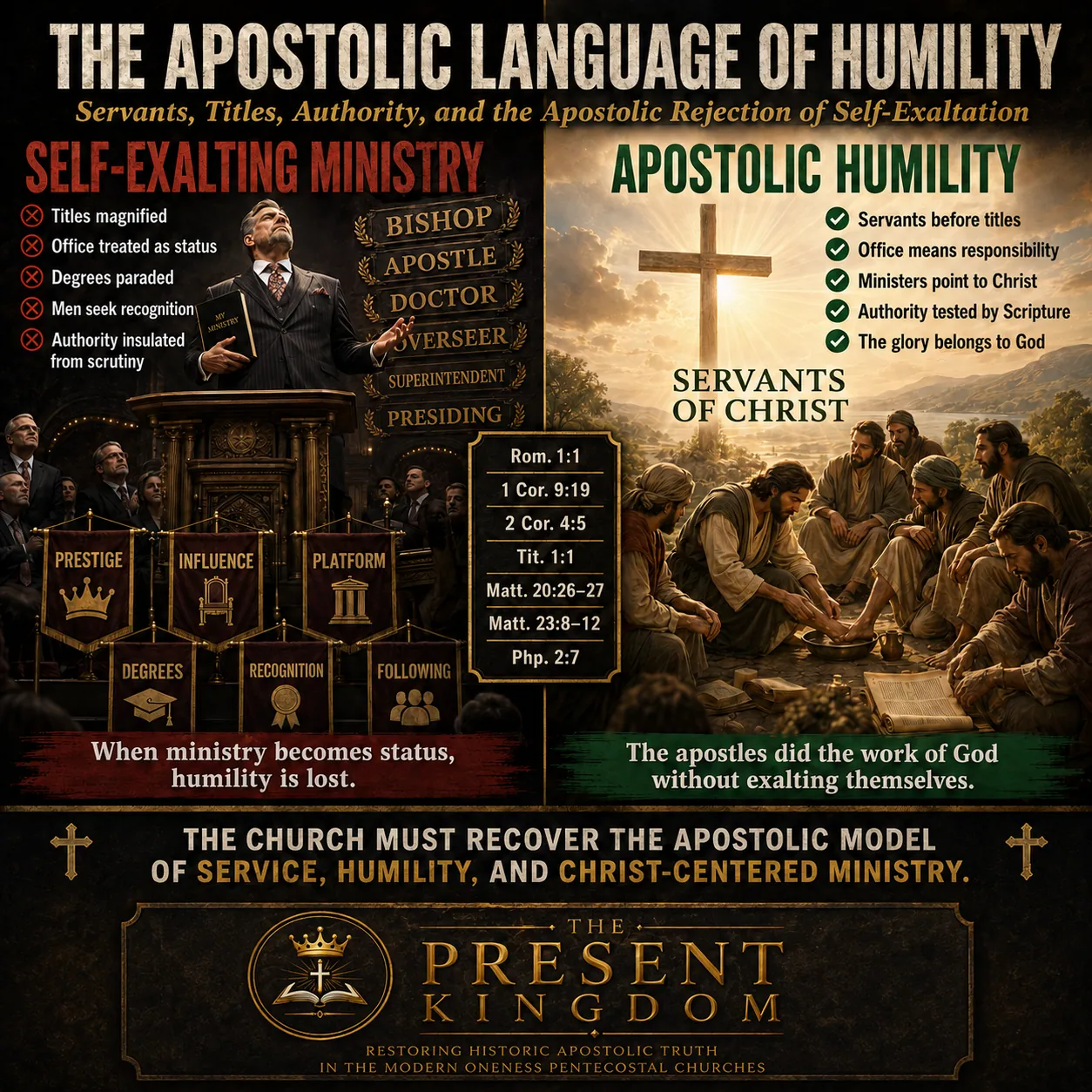

Servants, Titles, Authority, and the Apostolic Rejection of Self-Exaltation
Original work and inspiration by friend and beloved brother in Christ, Barry Grogan
Introduction
One of the clearest differences between the apostolic church and much of modern religious culture is the language ministers used about themselves. The apostles certainly acknowledged their God-given offices. Paul did not deny that he was an apostle. Peter did not deny that he was an apostle. But when they described themselves personally, they repeatedly chose words of service, humility, suffering, weakness, and responsibility rather than language designed to magnify status.
Paul opens Romans this way:
“Paul, a servant of Jesus Christ, called to be an apostle…”
Notice the order.
He is first a servant of Jesus Christ.
Then he is called to be an apostle.
The office is real, but the identity is servanthood.
Paul did not use apostleship as a platform for personal elevation. He treated it as a calling, a responsibility, and often a burden.
That pattern is seen throughout the apostolic writings.
Paul says:
“For though I be free from all men, yet have I made myself servant unto all, that I might gain the more.”
Again:
“for if I yet pleased men, I should not be the servant of Christ.”
And again:
“Paul, a servant of God, and an apostle of Jesus Christ…”
The office did not cancel the servant identity.
It reinforced it.
The same is true of the other apostles and leaders.
James writes:
“James, a servant of God and of the Lord Jesus Christ…”
Peter writes:
“Simon Peter, a servant and an apostle of Jesus Christ…”
Jude writes:
“Jude, the servant of Jesus Christ…”
John is introduced in Revelation as:
“his servant John”
The apostolic pattern is unmistakable.
These men had authority.
They had callings.
They had ministries.
They had offices.
But they did not build their identity around self-exalting religious titles.
They built it around service to Christ.
1. The Fivefold Ministry Is Real, but the Title Is Not the Glory**
We fully affirm the fivefold ministry as apostolic and still present in the church today.
Ephesians 4:11 plainly says:
“And he gave some, apostles; and some, prophets; and some, evangelists; and some, pastors and teachers.”
The issue is not whether these functions exist.
They do.
The issue is what men do with them.
A man called to apostolic work does not need to build a personality around the title “Apostle.”
A prophet does not need constant public recognition as “Prophet.”
A pastor does not need to turn the office into a social rank.
A teacher does not need status.
An evangelist does not need a platform centered on himself.
The calling is proved by the work.
The function is demonstrated by fruit.
The office is for serving the body, not elevating the man.
Paul's language is the opposite of modern title culture.
He says:
“Who then is Paul, and who is Apollos, but ministers by whom ye believed…”
Not celebrities.
Not spiritual royalty.
Not untouchable personalities.
Ministers.
Servants through whom others believed.
2. Paul's Language Was Consistently Self-Lowering
Paul certainly called himself an apostle, but his broader vocabulary about himself was overwhelmingly humble.
Paul’s repeated identification of himself as an apostle should also be understood in context. Unlike the original Twelve, Paul had not followed Christ during His earthly ministry, and his apostleship was openly questioned by some. He therefore had reason to establish that his calling came directly from Jesus Christ. “Am I not an apostle? … have I not seen Jesus Christ our Lord?” (1 Corinthians 9:1). “If I be not an apostle unto others, yet doubtless I am to you” (1 Corinthians 9:2). Likewise, he opened Galatians by identifying himself as “an apostle, (not of men, neither by man, but by Jesus Christ…)” (Galatians 1:1). In these passages Paul was defending the legitimacy and divine source of his ministry, not using the word “apostle” to manufacture personal prestige.
He described himself as:
servant
minister
steward
prisoner
weak
least
abased
nothing
He wrote:
“we are made as the filth of the world, and are the offscouring of all things unto this day.”
He said:
“I am the least of the apostles…”
He said:
“I have abased myself…”
He said:
“when I am weak, then am I strong.”
He said:
“though I be nothing.”
He called himself:
“less than the least of all saints”
And even:
“sinners; of whom I am chief.”
This was not fake humility.
It was Paul's theology of ministry.
The power was Christ's.
The calling was Christ's.
The fruit was Christ's.
The glory was Christ's.
Paul never needed to enlarge himself in order to prove his ministry.
3. Christ Himself Took the Form of a Servant
The apostolic pattern comes directly from Jesus.
Paul writes:
“But made himself of no reputation, and took upon him the form of a servant…”
That should settle the spirit of ministry.
If Christ made Himself of no reputation, why are ministers trying to build reputations?
If Christ took the form of a servant, why are ministers building religious status systems?
If Christ humbled Himself, why are churches producing men who need public recognition, titles, honor seats, introductions, credentials, and constant acknowledgment of rank?
Jesus said:
“whosoever will be chief among you, let him be your servant.”
The kingdom reverses worldly hierarchy.
The world says:
Rise.
Be recognized.
Be honored.
Be titled.
Be important.
Christ says:
Serve.
4. The Apostles Were Not Ashamed of the Word “Servant”
The passages are worth seeing together because they reveal the pattern:
- Romans 1:1 — “Paul, a servant of Jesus Christ, called to be an apostle…”
- Romans 14:4 — “Who art thou that judgest another man's servant?”
- Romans 16:1 — Phebe is called “a servant of the church.”
- 1 Corinthians 7:22 — “he that is called, being free, is Christ's servant.”
- 1 Corinthians 9:19 — “I have made myself servant unto all.”
- Galatians 1:10 — “the servant of Christ.”
- Philippians 2:7 — Christ “took upon him the form of a servant.”
- Colossians 4:12 — Epaphras is “a servant of Christ.”
- 2 Timothy 2:24 — “the servant of the Lord must not strive; but be gentle…”
- Titus 1:1 — “Paul, a servant of God, and an apostle of Jesus Christ…”
- Hebrews 3:5 — Moses “was faithful in all his house, as a servant.”
- James 1:1 — “James, a servant of God and of the Lord Jesus Christ…”
- 2 Peter 1:1 — “Simon Peter, a servant and an apostle of Jesus Christ…”
- Jude 1:1 — “Jude, the servant of Jesus Christ…”
- Revelation 1:1 — John is called “his servant John.”
The terminology is striking.
The greatest men in Scripture were not embarrassed by servanthood.
Modern ministers should not be either.
5. Titles, Rank, and the Desire to Be Seen of Men
The problem of religious self-exaltation goes deeper than the words printed before a minister's name. Jesus exposed the appetite beneath the title: the desire to be seen, recognized, honored, and treated as spiritually important.
“But all their works they do for to be seen of men...”
“And love the uppermost rooms at feasts, and the chief seats in the synagogues, And greetings in the markets...”
Christ was not merely criticizing bad manners. He was confronting a religious culture in which visible rank had become part of spiritual identity. Men wanted the seat that announced importance, the greeting that announced status, and the public recognition that separated them from ordinary believers.
That same appetite can survive in modern church culture. Special introductions, elevated seating, elaborate titles, public acknowledgment of rank, ceremonial honor, and constant reminders of office can slowly transform a calling to serve into a position to be admired.
The issue is not whether Scripture recognizes apostles, prophets, evangelists, pastors, teachers, elders, bishops, or other functions. It does. The issue is whether the function is being used to serve the body or whether the office has become a mechanism for magnifying the man.
“But he that is greatest among you shall be your servant.”
Jesus did not abolish leadership. He overturned the world's definition of greatness. In His kingdom, the greater the responsibility, the deeper the servant posture should become. Religious rank that produces distance, entitlement, or superiority is moving in the opposite direction from Christ.
A minister should not need the church to continually remind him that he is important. If God has called him, let him do the work. If God has given him authority, let that authority be demonstrated through truth, character, sacrifice, and fruit. The desire to be seen of men is not evidence of ministry. It is precisely the temptation Jesus warned religious leaders about.
6. Titles Can Become a Form of Self-Exaltation
There is nothing inherently sinful about identifying someone's function.
Paul was an apostle.
Timothy was an evangelistic worker.
James was a leader in Jerusalem.
Peter was an apostle. The problem is not the existence of titles themselves, but the spirit and purpose behind them. A title may simply identify a person’s function, responsibility, or calling, just as “treasurer” identifies the one responsible for finances or “pastor” identifies the one who shepherds a local congregation. But some titles are self-exalting in their very construction because they are designed to communicate superior spiritual rank, unusual authority, or special status. Terms such as “Chief Apostle,” “Anointed Prophet,” “Presiding Bishop,” or similar elevated designations can carry that spirit openly. To many outside such systems, the self-exaltation is obvious. Yet people immersed in personality-centered charismatic or apostolic cultures can become so accustomed to exalted titles that they no longer recognize what the titles themselves are communicating. What begins as sincere biblical vocabulary can become a culture of rank, prestige, and devotion to personalities.
The use of the word “pastor” is different. In itself, it is not necessarily self-exalting. It can simply identify the person who actually pastors, shepherds, and leads a local congregation. There is nothing inherently wrong with saying, “You should speak to the pastor,” or, “Have you talked to the pastor about this?” In those cases, the word is functioning as a practical designation of responsibility. The danger begins when a man uses the title Pastor to imply an authority Scripture never gave him, to place himself beyond correction, to demand unquestioning obedience, or to make disagreement with him seem equivalent to disagreement with God. At that point, the problem is no longer the word itself, but the spirit of authority and elevation being attached to it.
The same principle applies when there are multiple pastors, elders, teachers, evangelists, or other recognized workers within a congregation. Calling a man pastor because he actually pastors, teacher because he teaches, evangelist because that is his ministry, or elder because he serves in that recognized role does not automatically mean he is exalting himself. We should not condemn a man merely because a functional title accurately identifies who he is and what God has called him to do. My son calls me Dad because that is who I am in relation to him, and there is nothing prideful about acknowledging that I am his dad. I may even leave him a message saying, “Hey Isaac, this is Dad.” In the same way, ministry designations are not evil in themselves. The important distinction is whether the title simply identifies a real relationship, calling, or responsibility, or whether it is being used to create spiritual rank, superiority, or personal devotion. The spirit behind the title must be examined, not merely the existence of the title itself.
The biblical test is therefore not merely whether a title exists, but what it does. Does it clarify the work, or glorify the worker? Does it identify responsibility, or manufacture spiritual status?
When the title becomes part of a man's personal identity and prestige, something has shifted.
- “Apostle.”
- “Chief Apostle.”
- “Anointed Prophet.”
- “Senior Bishop.”
- “Reverend.”
- “District Superintendent.”
- “General Superintendent.”
- “Assistant General Superintendent.”
- “Assistant Pastor.”
- “Associate Pastor.”
- “Bishop.”
- “District Elder.”
- “Sectional Presbyter.”
- “Executive Presbyter.”
- “Executive Board Member.”
- “Dr.”
- “PhD.”
Titles can multiply until ministry begins to resemble a religious hierarchy rather than the servant model of the New Testament.
Jesus directly warned against religious status culture:
“But be not ye called Rabbi: for one is your Master, even Christ; and all ye are brethren.”
And:
“Neither be ye called masters: for one is your Master, even Christ.”
The point is not that every descriptive office word is forbidden.
The point is that Christ attacked the human desire for religious elevation.
He immediately follows with:
“But he that is greatest among you shall be your servant.”
That is the corrective.
Volume I established that apostolic authority is not measured by celebrity, domination, or impressive credentials. The question here is what office should produce in the man who carries it: greater accountability, not greater status.
7. Office Should Increase Responsibility, Not Status
A biblical office should make a man feel more accountable, not more important.
James warns:
“My brethren, be not many masters, knowing that we shall receive the greater condemnation.”
Greater ministry means greater judgment.
More responsibility.
More accountability.
More sacrifice.
Not greater prestige.
The higher the calling, the lower the servant should bend.
That is the apostolic model.
8. Modern Religious Hierarchies Under the Apostolic Microscope
Organization is not inherently sinful. Churches need order, coordination, accountability, administration, and men willing to carry responsibility. But organization becomes spiritually dangerous when administrative responsibility is converted into religious rank and rank becomes a measure of personal importance.
Modern church systems can easily create ladders of prestige. A minister may begin with local responsibility, move into sectional or district influence, receive increasingly prominent appointments, preach more prestigious meetings, obtain executive positions, and eventually be treated as belonging to a higher religious class.
Likewise, titles can multiply beyond biblical function: apostle, chief apostle, prophet, presiding bishop, superintendent, overseer, executive, chairman, and other designations may begin as descriptions of responsibility but become symbols of status. The question is not whether an organization may use administrative descriptions. The question is what spirit develops around them.
The same principle applies to academic titles. There is nothing wrong with education, scholarship, or earning a legitimate doctorate. But when “Dr.” becomes part of a minister’s religious identity and is repeatedly emphasized to establish spiritual weight, prestige, or authority, the church has again confused human credentials with apostolic calling. A doctorate may demonstrate academic achievement, but it does not make a man more anointed, more apostolic, or more spiritually authoritative. Paul was highly educated, yet when he defended his ministry he pointed not to academic rank, but to sacrifice, suffering, faithfulness, and the work Christ had entrusted to him. When a degree becomes a badge of spiritual status, education has stopped being a tool and has become another rung in the religious hierarchy.
“Whosoever will be chief among you, let him be your servant.”
Jesus places the entire hierarchy of His kingdom upside down. Greater responsibility should produce greater service, not greater privilege. The closer a man comes to the center of leadership, the more accountable, accessible, sacrificial, and humble he should become.
The apostolic church did have authority. But authority was not established by elaborate social rank. It came through calling, doctrine, character, spiritual fruit, sacrifice, and faithfulness. Paul could command churches in truth while still describing himself as their servant for Jesus' sake.
The modern church therefore has the right - and the responsibility - to place every hierarchy under the apostolic microscope. Does the structure make ministry more effective, or does it manufacture prestige? Does it protect the flock, or protect positions? Does it make leaders more accountable, or more untouchable? Does it direct attention toward Christ, or toward the men occupying the highest seats?
Administration can serve the church. Rank must never become the church's substitute for spiritual authority.
9. The Modern Church Needs to Recover Apostolic Language
The church needs to stop confusing titles with authority.
Authority comes from:
truth,
character,
calling,
fruit,
faithfulness,
and the Spirit of God.
A man does not become more apostolic because “Apostle” appears before his name.
A prophet does not become more prophetic because everyone is required to call him “Prophet.”
A pastor does not become more spiritual because the congregation treats him like royalty.
A bishop does not become more authoritative because his robe is elaborate.
The apostles did not need that kind of validation.
They served.
They suffered.
They preached.
They planted churches.
They corrected error.
They gave their lives.
And they called themselves servants.
10. Restoring the Servant Model
The answer to title culture and personality worship is not the destruction of ministry. It is the restoration of ministry to its apostolic purpose.
We fully affirm the fivefold ministry as apostolic and still present in the church today. But men called to those functions do not need to exalt the office into a personal title or boast in the position; they simply need to do the work God gave them to do and let Christ receive the glory.
An apostle should do apostolic work. A prophet should faithfully speak what God gives him. An evangelist should evangelize. A pastor should feed, protect, and care for the flock. A teacher should teach the Word accurately. The calling is demonstrated by the work, not created by the title.
Restoration also requires churches to stop rewarding religious self-promotion. Saints should honor faithful labor without manufacturing celebrity. Leaders should receive respect without demanding reverence. Offices should carry responsibility without becoming symbols of superiority.
The servant model does not weaken biblical authority. It purifies it. A man who knows he belongs to Christ can speak truth boldly without needing to defend his ego, status, or reputation. He can be corrected without collapsing. He can share responsibility without feeling threatened. He can send other men into ministry without fearing competition.
This is what the church needs: not less ministry, but ministry stripped of vanity; not less authority, but authority cleansed of domination; not fewer callings, but men who understand that every calling is an assignment to serve.
“He that is greatest among you shall be your servant.”
The church does not need to abolish the fivefold ministry. It needs to recover the spirit in which Christ gave it.
Conclusion: The Title Is Not the Ministry
We believe in apostles.
We believe in prophets.
We believe in evangelists.
We believe in pastors.
We believe in teachers.
But the men who fill those functions do not need to exalt those callings into personal titles of prestige.
They need to do the work.
The apostles acknowledged their offices, but their personal language was overwhelmingly marked by humility.
Servant.
Minister.
Steward.
Prisoner.
Weak.
Least.
Nothing.
That is not accidental. That is the spirit of apostolic ministry.
The true apostle does not need people constantly calling him Apostle.
The true prophet does not need people constantly calling him Prophet.
The true pastor does not need to dominate the flock. The true minister serves.
Jesus gave the standard:
“he that is greatest among you shall be your servant.”
And Paul gave the identity:
“Who then is Paul, and who is Apollos, but ministers by whom ye believed…”
The office belongs to the work.
The servant belongs to Christ.
And the glory belongs to God.